

If you are new to the UFC, the first thing to learn is that fights are not matched by size alone. Every fighter competes in a weight class, and the class decides who can fight whom, who can win a title and how each division is ranked.
The men's divisions
The men's divisions run from flyweight, with a limit of 125 pounds, through bantamweight (135), featherweight (145), lightweight (155), welterweight (170), middleweight (185) and light heavyweight (205), up to heavyweight, which goes up to 265 pounds.
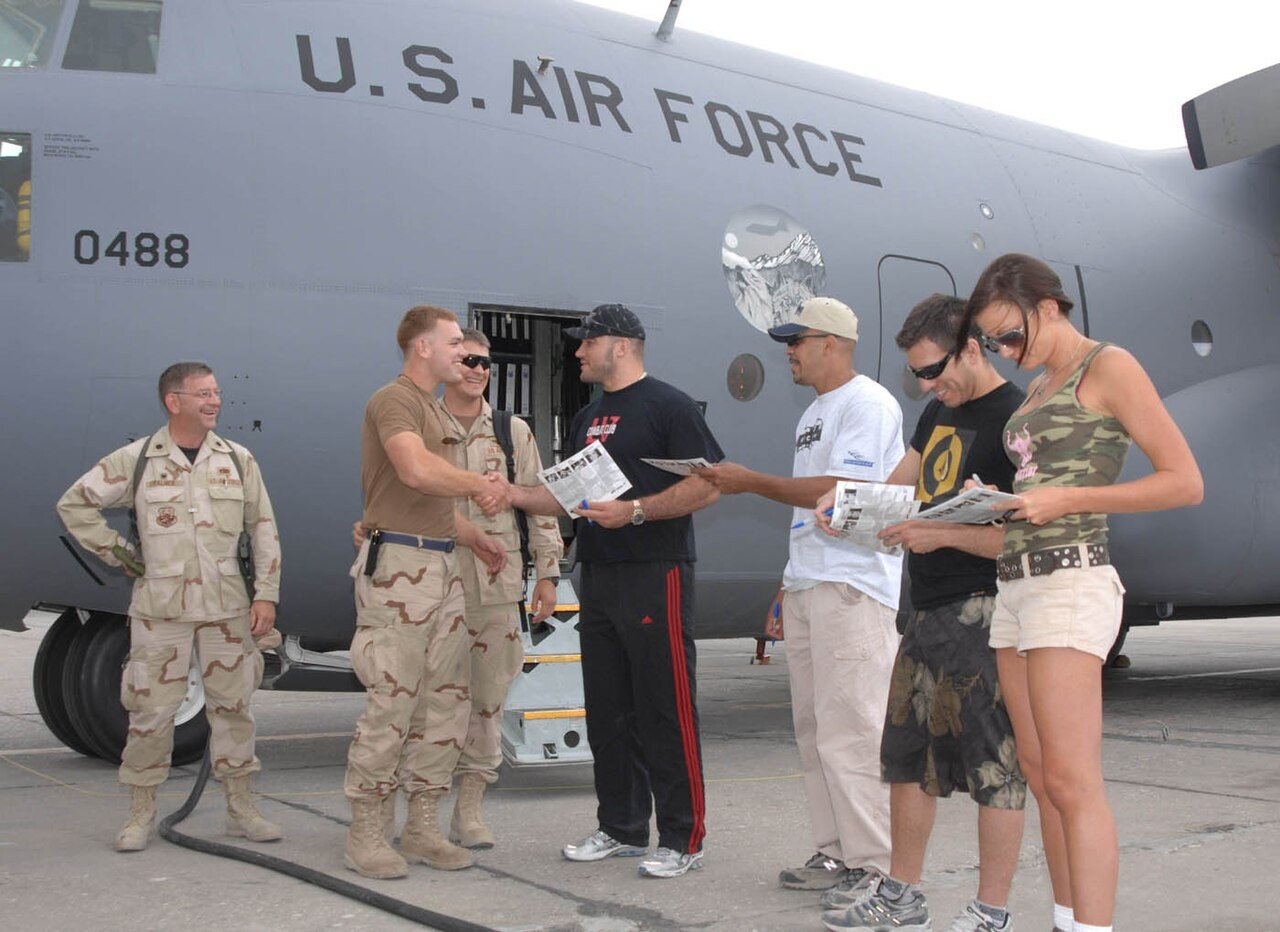
UFC fighters meet US Air Force personnel at Bagram Air Base, Afghanistan, in 2007. Photo: Senior Master Sergeant Kim Allain, US Air Force, public domain, via Wikimedia Commons.
The women's divisions
Women compete in four divisions: strawweight (115 pounds), flyweight (125), bantamweight (135) and featherweight (145).
Why weigh-in day matters
Fighters step on the scale the day before the fight. Missing the limit usually means a fine taken from the fighter's purse, and it can cause the whole bout to be changed or cancelled. Many fighters cut water weight in the final days and then rehydrate after the weigh-in, which is why they can look much bigger in the cage than on the scale.
How long a fight lasts
Most fights are scheduled for three rounds of five minutes. Title fights and main events go to five rounds. If nobody finishes the fight, three judges score each round and the fighter who wins more rounds usually takes the decision.
Once you know the weight classes, rankings, title fights and super-fights start to make sense, and so does the way fighters move up or down a division to find the best matchup.